Peer Tutor-Based Quranic Learning in Elementary Schools
Abstract
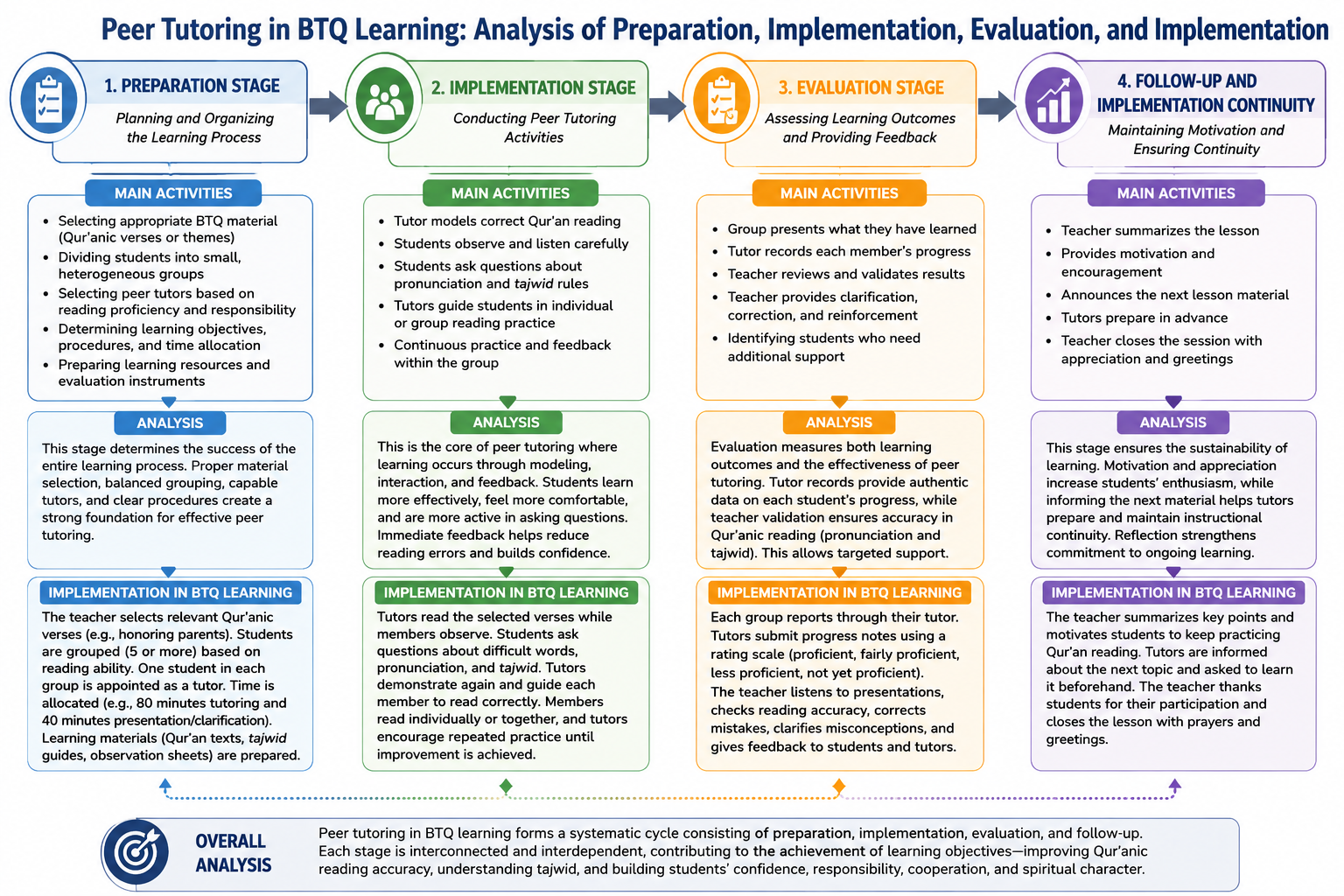
The peer tutoring method aims to provide students with greater freedom and opportunities to interact freely and reduce their perceived inadequacy towards their teachers. This is especially true in terms of reading and writing the Quran well and correctly. The research method used is qualitative with a library research approach , also known as literature study, with data analysis using content analysis. The peer tutoring method is deemed essential to improve students' ability to read and write the Quran well and correctly and foster students' enthusiasm for studying the Quran. The implementation of the peer tutoring method must go through stages, namely preparation, implementation, and evaluation stages. In implementing the peer tutoring method, there are three series of activities that must be followed: initial activities, core activities, and final or closing activities. By implementing this peer tutoring method, students become enthusiastic and motivated to continue developing their ability to read and write the Quran well and correctly.
Downloads
References
Alfi, Dewi Zainul, and Khoirotul Idawati. The Effectiveness of the Peer Tutor Learning Model in Improving the Al-Qur'an Reading Skills of Students in the Ba' Da Subuh Study Program at the Tebuireng Islamic Boarding School . 7, no. 2 (2022): 27–47.
Annasthasya, Dellia, Isnaeni Alfindoria, Suciati Rahayu, and Oki Iqbal Khair. Qualitative Research Methodology: A Literature Review in the Context of Education . nd, 423–29.
Wise, Asril. Symbolic Interactionism Theory Approach in Qualitative Research Methodology . 4, no. 2 (2025): 2244–56.
Di, Tanzil, RA Mambaul, and Ulum Bata-bata Panaan. ISSN 1979-2794 e-ISSN: 2655-6634 . 1979.
Hermansyah et al., “The Effectiveness of the Peer Tutor Method in Improving Number Sense Skills of Grade VII Students of SMP Negeri 1 Duripoku”, MUST: Journal of Mathematics Education, Science and Technology, Vol. 5, no. 1, (2020): 95–105.
Hamsiah, A., and Mas Muhammadiah. The Implementation of the Peer Tutor Method on Students' Activeness and Learning Outcomes in Makassar City. Introduction to Research Methods. 4, no. 2 (2024): 227–31. https://doi.org/10.35965/bje.v4i2.4453.
Ministry, Authority, Internal Religion, Implementation of Education, Basis and, Review of, and Legal Certainty. Journal of Legal Compilation . 10, no. 2 (2025).
Material, Mathematics, and the Principles of Sets. Pancasakti Mathematics and Natural Sciences Education Journal . 3 (2019): 43–52.
Minangsari, Ratih Permata, Rivanna Citraning Rachmawati, Susilo Wardani, Jl Kartini, Bawen No, and Semarang Regency. Marwan, Iganadia. “Students’ Activities in Participating in the Peer Tutor Al-Quran Recitation Program and Their Ability to Read the Quran in Class X of SMA Angkasa Lanud Sulaiman, Bandung Regency.” Journal of UIN Sunan Gunung Djati (2022). 19, no. 1 (2025): 160–65.
Ningsih, Wahyu. The Effectiveness of the Peer Tutoring Learning Model in Learning to Write Observation Report Texts for Class VIII Students of SMP Negeri 39 Bulukumba . 10, no. 2 (2024): 2051–61.
Nisa, Khairun. Application of Peer Tutoring Method to Improve Learning Outcomes of Reading the Qur'an (Surah Al-Maa'un in Fifth Grade Students of SD Negeri 1 Tewah) . April 2, 2026. https://e-proceedings.iain-palangkaraya.ac.id/index.php/PPGAI/article/view/936.
Nurfajriani, Wiyanda Vera, Muhammad Wahyu, Ilhami Arivan, Rusdy Abdullah Sirodj, and M. Win Afgani. No Title . 10, no. September (2024): 826–33.
Saepudin, Sandi, Deni Pratidiana, and Rusdian Rifa. Improving Mathematical Communication Skills of Students of SMA Negeri 1 Panggarangan Through Peer Tutoring Method with Youtube Media . 10, no. 2 (2025): 137–45. https://doi.org/10.30653/003.2024102.347.
Sayangan, Yohanes Vianey, Luxcya Martir, Wona Una, and Veronika Yuliana Beku. Journal of Mathematics and Natural Sciences Education . 14, no. September (2024): 757–66.
Supriyatna, Alliyah Putri, Nurdinah Hanifah, and I. Isrok. Implementation of the Peer Tutoring Method in Improving the Social Skills of Fourth Grade Elementary School Students . 5 (2024): 397–408.
Technology, Journal, Education and Learning Jtpp, Fahriana Nurrisa, and Dina Hermina. Qualitative Approach in Research: Strategy, Stages, and Data Analysis Journal of Educational Technology and Learning (JTPP) . 02, no. 03 (2025): 793–800.
Tisnawati, Tri Endang, and Zahra Alfina Putri. Peer Tutor-Based Al-Qur'an Learning Management Strategy in Improving Al-Qur'an Reading Competence . 4, no. 2 (2025): 277–85. https://doi.org/10.35719/managiere.v4i2.2464.
Utami, Ratnasari Diah, Harun Joko Prayitno, and Eka Destriyanto Pristi. Empowering Teachers and Facilitators in Multigrade Learning at the Malaysian Learning Center Using the Pancasila Student Profile Approach . 5, no. 1 (2023): 96–106. https://doi.org/10.23917/bkkndik.v5i1.22889.
Copyright (c) 2026 Muhammad Irfan

This work is licensed under a Creative Commons Attribution-ShareAlike 4.0 International License.